
RECAP of the May 13, 2026, EEC Board Meeting: Updates on the FY2027 Budget, Informal Child Care Rate Increase Proposal, Residential Programs Regulations, and Family Child Care Capacity Pilot.
At Neighborhood Villages, we prioritize keeping up with the policy landscape in the early education and care field, both across the country and in Massachusetts. That includes tuning-in to the monthly meetings of the Massachusetts Board of Early Education and Care (“EEC Board”), to stay apprised of updates and to identify opportunities for how we can work with government and other stakeholders to improve our early education and care system.
The primary topics of this month’s Department of Early Education and Care (EEC) Board meeting included updates on EEC’s: (1) Fiscal Year 2027 Budget, (2) Informal Child Care Reimbursement Rate Increase Proposal, (3) Residential Programs Regulations, and (4) Family Child Care Capacity Pilot.
For additional details on any of the meeting topics, view the slides here or watch the recording on YouTube.
Here’s what you need to know…
If You are an Early Childhood Educator:
1) Commissioner Amy Kershaw announced that EEC has partnered with the Mass Cultural Council to provide early educators with the same discounts provided to K-12 teachers for museums, cultural institutions, and businesses. You can find a directory of the discounts here.
2) Commissioner Kershaw announced that, as May is Mental Health Awareness Month, EEC’s Behavioral Health Team is hosting events to share information about the resources available to support children’s, educators’, and directors’ mental health.
If You are a Parent/Guardian or Child Care Advocate:
1) Commissioner Kershaw announced that the MyChildCareMA portal, EEC’s family portal where families can apply for Child Care Financial Assistance, is live. EEC also launched the first phase of their professional portal for educators and staff. This phase is focused on EEC’s learning management system and the EEC Essentials Refreshers Course.
2) EEC staff provided an update on EEC’s Fiscal Year (FY) 2027 Budget and the FY2026 Fair Share Supplemental Budget. In January the Governor released her FY2027 budget proposal. In April and May, the MA House of Representatives and Senate separately released their respective budget proposals. The budget now goes to a conference committee to reconcile the differences between the House’s and Senate’s respective proposals. Following conference and final passage by the Legislature, the budget bill will go to the Governor for her approval. More on Massachusetts’ FY2027 budget process can be found here.
In January, the Governor also issued an FY2026 Fair Share Supplemental Budget proposal, which follows the same budget process as the FY2027 operating budget. This supplemental budget, however, appropriates funds that can be spent across FY2027 through FY2029.
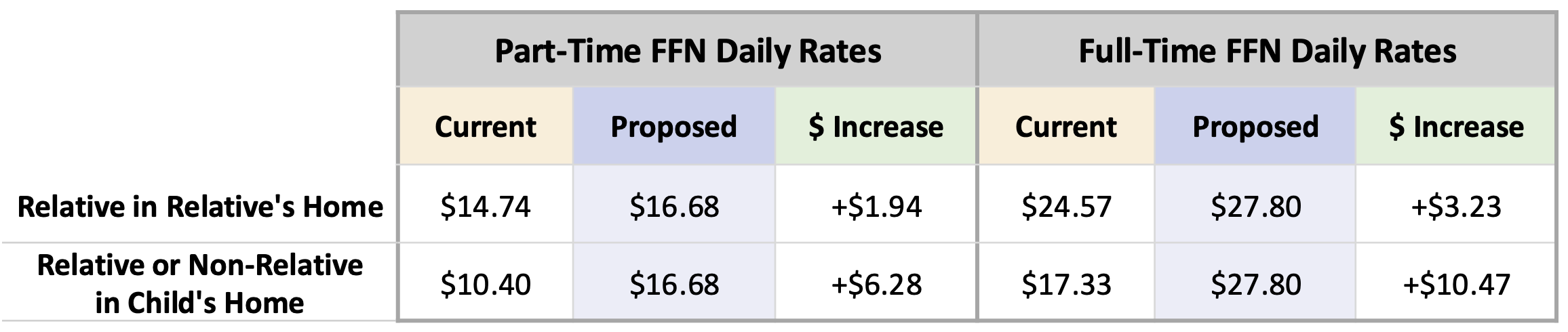
3) EEC staff discussed Family, Friend, and Neighbor Care (FFN) and proposed an increase to the Informal Child Care (ICC) Reimbursement Rate. FFN care is generally defined as care provided by someone the family knows, such as a friend, grandparent, aunt, or neighbor. EEC refers to FFN care as ICC: licensed exempt care provided by a relative or non-relative for a child receiving Child Care Financial Assistance (CCFA). ICC caregivers and families must be approved by EEC in order to receive CCFA reimbursement payments. (If a FFN provider is not receiving CCFA reimbursement, they are outside the purview of EEC. Most FFN care operates outside of EEC’s purview.)
EEC has been exploring the ICC CCFA reimbursement rate structure. They recognized that current ICC daily rates are low and make up a small portion of the CCFA budget ($2 billion). EEC is seeking to increase the ICC CCFA rates in the interest of centering family access, affordability, and choice. EEC’s proposal is an incremental step that seeks to invest in the care being provided rather than the location of the care. It simplifies and aligns the rates to increase equity across ICC settings. The proposal (1) raises the informal rate for care in the child’s home to match the rate for care in a relative’s home and (2) includes an additional increase to all rates. See below a chart comparing the current ICC CCFA rates and the newly proposed rates. The rate increase is estimated to cost $990,000 and, if approved, would be effective July 1, 2026. The Board will vote on this proposal next month.
If You are a Provider:
1) The EEC Board voted to approve the revisions to EEC’s Residential Programs Regulations. Residential programs provide group care and housing for children and youth in a facility setting outside of their family home. Many of the children residing at these programs have complex behavioral health and/or social-emotional needs or are otherwise in need of additional complex support.
EEC’s revisions are geared toward modernizing and streamlining language, incorporating an evidence-based approach, and enhancing clarity. The revised regulations will become effective on November 17, 2026.
Next steps:
EEC’s Policy, IT, and Licensing teams will work together to build and implement the systems and supports necessary to ensure successful implementation.
The residential workgroup will remain in place to facilitate feedback.
EEC will work with providers to help them be in compliance with the regulations.
Ongoing technical assistance will be available for providers and programs.
2) EEC staff discussed EEC’s new Family Child Care (FCC) Capacity Pilot. In the FY2025 budget there were a number of changes to EEC’s statute. One of the changes eliminated the 10 child limit for FCCs. Although this language removed the limit in statute, EEC’s regulations still have a 10 child limit. The change to the statute has enabled EEC to consider FCC group sizes and ratios as part of its ongoing regulatory review.
EEC has decided to do a pilot to learn about the impact of expanding FCC’s child limit from 10 to 12 children. The pilot will follow a small group of FCC providers granted permission to serve up to 12 children and collect operational data and feedback. This information will inform future regulatory, policy, and support decisions related to FCC capacity, staffing ratios, groupings, and licensing structures. In developing the pilot, EEC sought feedback from licensors, the FCC educator workgroup, and the FCC systems workgroup.
EEC is seeking to include 25-30 programs from different regions. Eligible FCC providers include providers that are in good standing, licensed for 10 children, and have operated continuously with a licensed capacity of 10 for at least three full years. More detailed participation requirements and selection criteria are outlined in the slides.
EEC will begin accepting applications for the pilot in June. Applications will be reviewed in July, and the pilot would begin in August with EEC working with the pilot participants to collect data and gather feedback.
The next EEC Board meeting will be on June 10, 2026 in Boston.