
At Neighborhood Villages, we prioritize keeping up with the policy landscape in the early education and care field, both across the country and in Massachusetts. That includes tuning in to the monthly meetings of the Massachusetts Board of Early Education and Care (“EEC Board”), to stay apprised of updates and to identify opportunities for how we can work with government and other stakeholders to improve our early education and care system.
The primary topics of this month’s Department of Early Education and Care (EEC) Board meeting included updates on: (1) EEC’s Fiscal Year 2027 Budget, (2) Informal Child Care Reimbursement Rate Increase, (3) IT Modernization, and (4) EEC’s Key Area of Focus for Fiscal Year 2026.
For additional details on any of the meeting topics, view the slides here or watch the recording on YouTube.
Here’s what you need to know…
If You are an Early Childhood Educator:
1) Commissioner Amy Kershaw announced that the application process for the Early Childhood Educator Student Loan Repayment program has closed. EEC received 430 applicants. They are reviewing the applications now.
2) Commissioner Kershaw announced that they are still accepting applications for the Early Childhood Education Scholarship program. EEC received 578 applicants. You can learn more about the program and how to apply here.
If You are a Provider:
1) Commissioner Kershaw announced that Governor Maura Healey issued new statewide guidance to help organizations in Massachusetts understand their rights and responsibilities and enable staff to respond appropriately if they encounter federal immigration officers. You can find the guidance for early education and child care organizations here.
2) Commissioner Kershaw announced that those eligible for the Family Child Care (FCC) Capacity Pilot have been contacted. EEC received a lot of enthusiastic responses from providers. The pilot will follow a small group of FCC providers granted permission to serve up to 12 children and collect operational data and feedback in order to help EEC learn about the impact of expanding FCC’s child limit from 10 to 12.
3) Commissioner Kershaw announced that due to attrition in the Commonwealth Cares for Children program, EEC is able to allow new providers to participate in the program. Due to level funding, EEC hasn’t been able to allow new providers into the program for some time but now 133 new providers, representing 1,900 seats, will join the program. Eighty-three percent of the providers are FCC providers.
4) EEC staff discussed EEC’s IT modernization progress for the professional portal. EEC is consolidating and modernizing the tools that the early childhood education workforce uses for professional development to create a “one-stop shop” for educators, with a modern and user-friendly interface and to streamline EEC operations through improved administrative experiences. Phase one of developing the professional portal involves updating and bringing existing workflows into one system. Currently, through the portal, educators can apply for certifications, supervisors can review educators’ work experience, and educators can access the new StrongStart system. EEC is still working on EEC team members’ ability to process applications with the administrative interface.
Phase two and additional phases of the modernization process will include more improvements and enhanced functionality and workflows including, updates for EEC certification, a program level dashboard where leaders can check and document educator qualifications, and integration of the professional registry and elimination of EEC’s Professional Qualifications Registry.
If You are a Parent/Guardian or Child Care Advocate:
1) Commissioner Kershaw announced that EEC expects to make announcements about the Employer Child Care Innovation Fund over the summer. The program is expected to award 3-5 grants to employers to test out different approaches that can better support their employees' child care needs.
2) Massachusetts State Senator Jason Lewis, who is retiring from the Legislature at the end of his term, attended the board meeting so the Board could express their gratitude for his service. The Board thanked him and showed appreciation for his support of the sector throughout the years. Senator Lewis also shared appreciation for EEC, his colleagues in the state house, and various stakeholders that he worked with during his tenure.
3) The Board voted to approve a salary increase for Commissioner Kershaw and the Fiscal Year 2027 meeting schedule.
4) EEC staff provided an update on EEC’s Fiscal Year (FY) 2027 Budget and the FY2026 Fair Share Supplemental Budget. In January the Governor released her FY2027 budget proposal. In April and May, the MA House of Representatives and Senate separately released their respective budget proposals. The budget is now in front of a conference committee to reconcile the differences between the House’s and Senate’s respective proposals. Following conference and final passage by the Legislature, the budget bill will go to the Governor for her approval, veto, or veto in part. See the picture below to see how the Senate’s budget proposal compares to the Governor’s budget proposal.
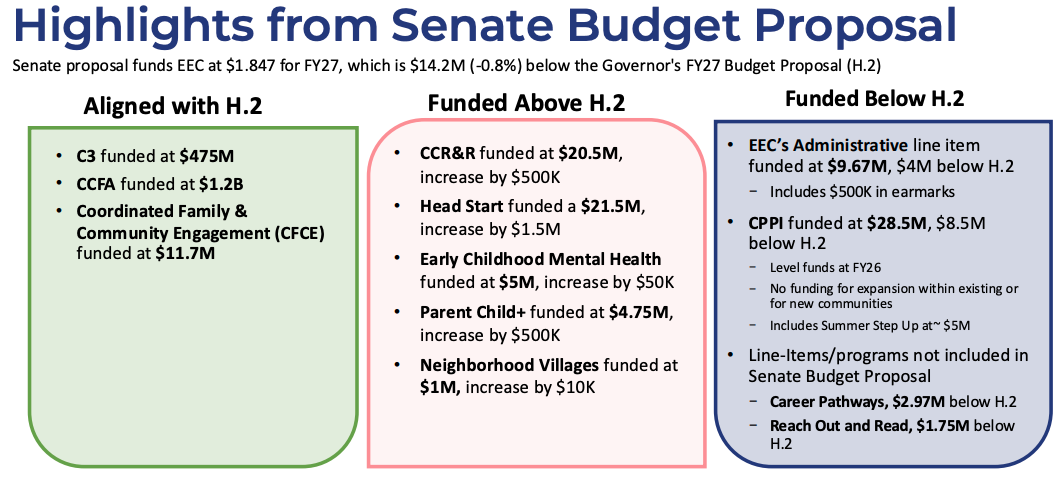
Based on the Senate’s proposal, EEC identified four watch areas: Commonwealth Preschool Partnership Initiative (CPPI), EEC’s Administrative line item, Career Pathways, and Reach Out and Read. With the level of funding proposed in the Senate’s budget for CPPI, EEC would not be able to expand into other communities and programs with planning grants would not be able to receive implementation grants. The decrease in funding for EEC’s Administration line item would cause EEC to reduce its staff and negatively impact its IT modernization efforts. EEC hopes that the Governor’s proposal for EEC’s Administration line item is represented in the Conference Committee budget proposal as it would restore them to their FY2025 funding level. Lastly, neither Career Pathways nor Reach Out and Read are funded within the Senate’s budget proposal.
In January, the Governor issued a FY2026 Fair Share Supplemental Budget proposal, which follows the same budget process as the FY2027 operating budget. This supplemental budget, however, appropriates funds that can be spent across FY2027 through FY2029. On June 2, 2026, the Conference Committee released their budget proposal. It is now before the Governor awaiting her approval, veto, or veto in part. The supplemental budget proposes the following:
$150 million transfer to the High-Quality Early Education and Care Affordability Fund which is used in the FY2027 Budget for CCFA;
$10.7 million for CCFA contracted seats;
$7.5 million for early educator’s’ loan forgiveness program;
$8 million to reduce the income-eligible waitlist;
$20 million for Literacy Launch; and
$975,000 for direct investments for individual early education and care programs.
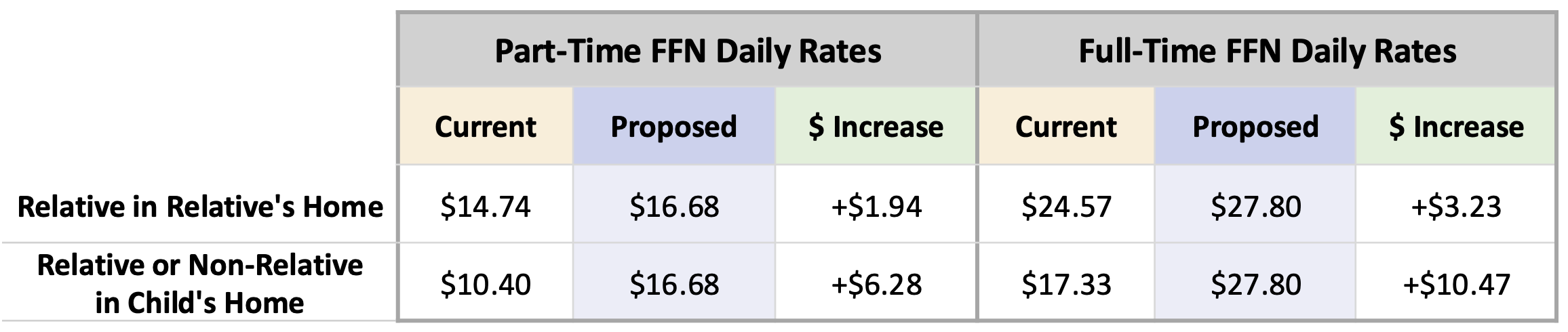
5) EEC staff discussed Family, Friend, and Neighbor Care (FFN) and the Board voted to increase the Informal Child Care (ICC) CCFA Reimbursement Rate. FFN care is generally defined as care provided by someone the family knows, such as a friend, grandparent, aunt, or neighbor. EEC refers to FFN care as “ICC” licensed exempt care provided by a relative or non-relative for a child receiving Child Care Financial Assistance (CCFA). ICC caregivers and families must be approved by EEC in order to receive CCFA reimbursement payments. (If an FFN provider is not receiving CCFA reimbursement, they are outside the purview of EEC. Most FFN care operates outside of EEC’s purview.)
EEC increased the ICC CCFA rates in the interest of centering family access, affordability, and choice. The increase is an incremental step that seeks to invest in the care being provided rather than the location of the care. It simplifies and aligns the rates to increase equity across ICC settings. It (1) raises the informal rate for care in the child’s home to match the rate for care in a relative’s home and (2) includes an additional increase to all rates. See below a chart comparing the current ICC CCFA rates and the new approved rates. The rate increase is estimated to cost $990,000 and will be effective July 1, 2026.
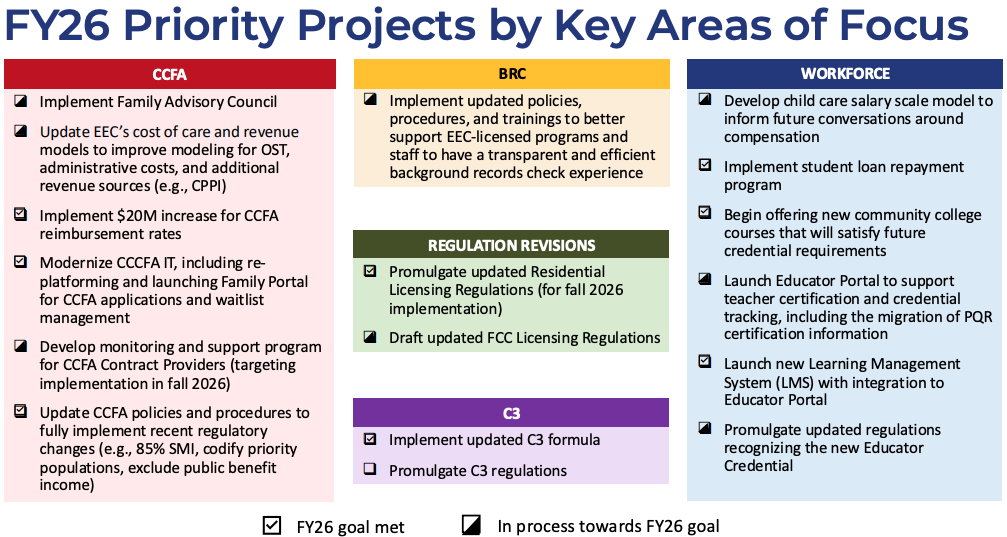
6) Commissioner Kershaw reviewed the work EEC and the Board accomplished in FY2026. EEC’s key areas of focus in FY2026 was on Child Care Financial Assistance, the background record check process, regulation revision, the workforce, and C3. EEC has been able to accomplish several goals and is still working on others. Some of the completed goals include rate increases for CCFA, launching the family portal, and discussing different parts of the system they haven’t talked about before like the Coordinated Family and Community Engagement grants and programs. See the picture below for a chart of the goals EEC has been able to accomplish and the projects they are still working on.
Next year, Commissioner Kershaw looks forward to talking more about family child care systems, capital investments, IT modernization, and educator credentialing. There will be a strategic planning meeting with the Board before the September board meeting.
The next EEC Board meeting will be on September 9, 2026 in Boston.