
RECAP of the January 14, 2026 EEC Board Meeting: Updates on EEC’s Child Care Financial Assistance FY2026 Rate Increase, Commonwealth Cares for Children Program, and Employer Child Care Innovation Fund
At Neighborhood Villages, we prioritize keeping up with the policy landscape in the early education and care field, both across the country and in Massachusetts. That includes tuning in to the monthly meetings of the Massachusetts Board of Early Education and Care (“EEC Board”), to stay apprised of updates and to identify opportunities for how we can work with government and other stakeholders to improve our early education and care system.
The primary topics of this month’s Department of Early Education and Care (EEC) Board meeting included updates on EEC’s: (1) Child Care Financial Assistance Fiscal Year 2026 Rate Increase, (2) Commonwealth Cares for Children Program, and (3) Employer Child Care Innovation Fund.
For additional details on any of the meeting topics, view the slides here or watch the recording on YouTube.
Here’s what you need to know…
If You are a Provider:
1) Commissioner Amy Kershaw announced that the application for the Small and Large Capital Grant for early education and out-of-school-time programs are both live. Funding supports renovations and construction projects to expand capacity and improve the quality and accessibility of learning environments for children, ensuring they have safe, inclusive, and developmentally appropriate spaces to learn, play, and grow. You can find more information about it here.
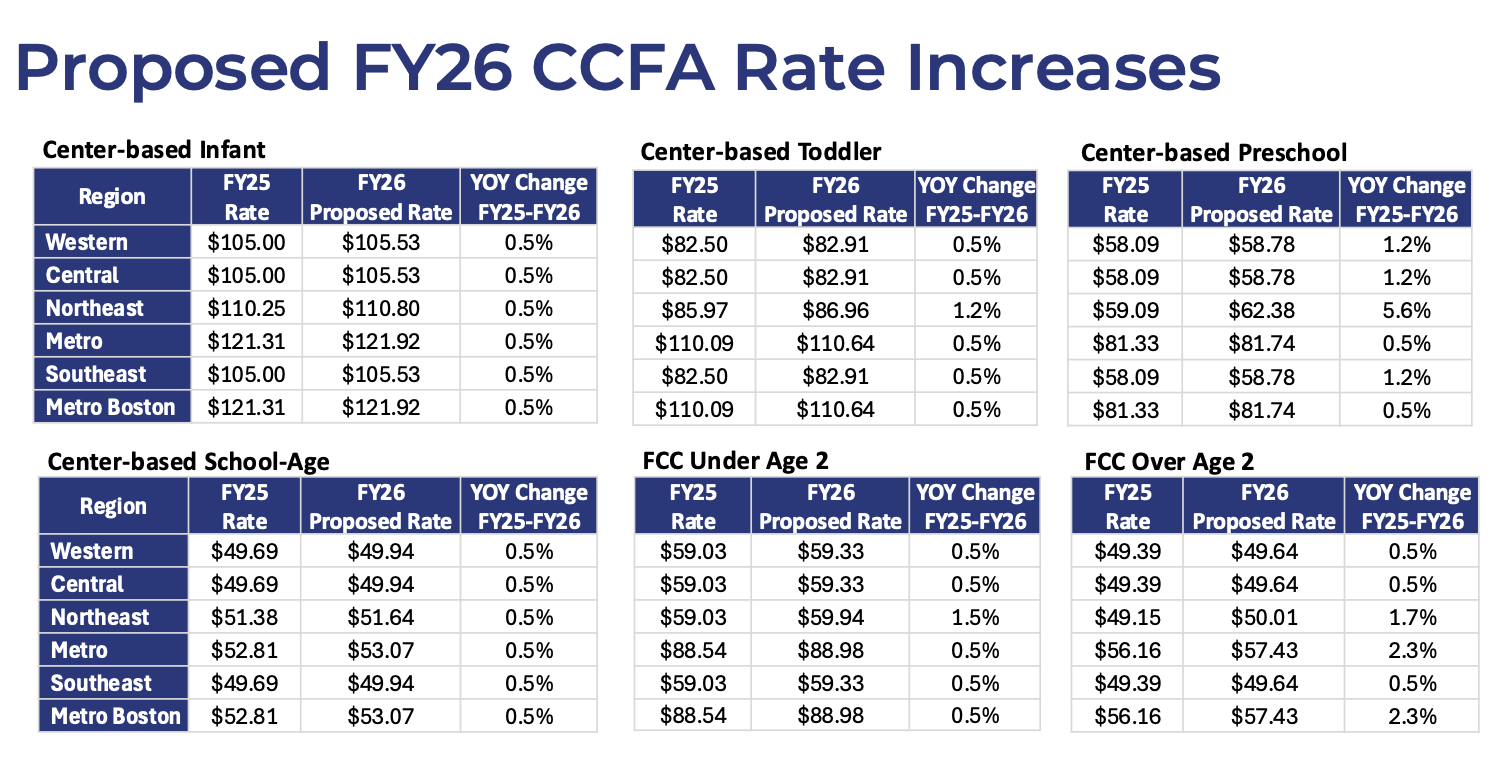
2) EEC reviewed their progress on closing the gap between the cost of care and their Child Care Financial Assistance (CCFA) reimbursement rates, research on the cost of care and their CCFA rates, and their proposed rate increase based on funding that was appropriated in the Fiscal Year (FY) 2025 Fair Share Supplemental Budget.
Over the last several years, EEC has been on a journey to close the gap between the cost of care and their rates. In working toward this goal, EEC worked with a research organization to do a comprehensive study on the cost of care and used that research to increase rates. Since FY2019, $248 million has been appropriated by the Legislature to increase their rates allowing EEC to double the average infant rate and similar average increases in toddler and preschool rates. This means additional funding for program operations, salary increases, and expanded options for families.
Last year, the Legislature appropriated $20 million for a rate increase specifically for center-based child care (CBC) and family child care (FCC). This money is a one time allocation of funds to increase rates for these providers. With EEC serving more children and families than ever before, at higher rates, these funds will not go as far as it would have in the past, and EEC is not able to make all the changes that stakeholder input and data show are needed. However, in making this proposal their guiding priorities were to make incremental progress, consider geographic equity, support program operations, promote family access and affordability, and recognize that costs are increasing for all programs.
EEC’s proposal includes two approaches to administering the rate increase. They proposed a rate increase across all rate types and additional select increases based on the cost of care and tuition prices. EEC proposed to increase both CBCs’ and FCCs’ rates across the board by 0.5%. On average, this is a $0.40 increase per day, but the amount will vary as it is based on current rates which vary by location, age, and program type. In addition, for CBCs, EEC proposed (1) an adjustment to preschool rates for the Western, Central, Southeast, and Northeast regions as these rates have fallen below the cost of care; and (2) an adjustment for toddler rates in the Northeast region to bring the rates close to median tuition prices. For FCCs, EEC proposed (1) an adjustment to rates for children over the age of two for the Northeast, Metro, and Metro Boston regions as these rates are furthest from the cost of care; and (2) an adjustment for children under the age of two for the Northeast region to bring the rate more in line with the cost in the other regions. Pursuant to Massachusetts law and the Collective Bargaining Agreement between SEIU Local 509 and EEC, the rate structure for FCCs is subject to negotiation. See below the proposed rate increases.
Make it stand out
Whatever it is, the way you tell your story online can make all the difference.
Next steps: EEC will put the proposal before the Board for a vote at the February 2026 Board meeting. If approved, the increase would be retroactive to July 1, 2025. In the spring, EEC will examine informal child care rates and discuss it with the Board.
3) EEC provided an update on the Commonwealth Cares for Children Grant Program (C3). In November, EEC launched its November application for C3. They are currently recalculating the monthly grant amount providers will receive for the rest of the fiscal year. The application included an attestation stating that providers were willing to accept families that have CCFA vouchers. Many of the programs agreed to the attestation. A small number, 46 programs, have stated they would not agree and have unenrolled from C3. Also, EEC plans to provide technical assistance to providers on their requirement that 50% of C3 funds must be allocated to workforce related expenses. A majority of programs are using their C3 funds in this manner.
Using data collected from C3, EEC provided updated information on child care in the Commonwealth, C3, and how providers used C3 funds in FY2025. The number of early education and care programs and capacity of programs continue to grow. However, growth of programs is outpacing the availability of C3 funding. Since July 2025, new programs haven’t been able to access C3 funds. If EEC were to open C3 to new programs that would mean less money for each program. Right now, EEC is focused on providing funding for the programs they already serve. The following are some highlights of EEC’s findings on how providers are using C3 funds:
CBCs spent almost 80% of funds on workforce related expenses and FCCs spent almost 90% on compensation, professional development, and occupancy related expenses.
Educators' wages are growing but remain low. Since 2021, CBC educators’ average wages have increased more than $4 per hour.
Educators continue to leave their roles at high rates, but these rates are decreasing.
C3 is helping programs support family affordability by delaying programs’ plans to increase tuition, reducing tuition costs for families, reducing or eliminating additional fees, and more.
Programs rely on a variety of strategies to financially support families beyond CCFA like reducing child care tuition for staff.
4) EEC and the Commonwealth Corporation Foundation (CCF) provided an overview of and update on the Employer Child Care Innovation Fund (EECIF). EECIF is a competitive matching grant program to help employers support working families in the Commonwealth. In the FY2025 budget, the Legislature provided $2.5 million for the fund. In the fall and winter, EEC put out the request for expressions of interest. Thirty-seven applicants from different regions across the state expressed interest and submitted a variety of concept ideas from sector capacity building and capital investment grants to shared cost models. They were given feedback on their letters of interest and all of them were invited to apply for the request for proposals. The request for proposals will be posted soon. Applicants will have six weeks to apply and another series of opportunities to receive feedback. The Fund will provide 3-4 awards ranging between $250,000 to $1 million for projects that will be implemented over the next two years. They are interested in projects that can be scaled and implemented across the Commonwealth. Once selected awardees will be onboarded and there will be a community of practice that will meet quarterly. Research support will be provided to the awardees to measure the outcomes of the pilots.
If You are a Parent/Guardian or Child Care Advocate:
1) Commissioner Kershaw addressed the allegations made in Minnesota regarding fraud in child care that have spread across the country and in Massachusetts. She expressed that there are no credible allegations in Massachusetts. EEC is regularly audited and operating in alignment with federal and state law and requirements. It is also monitoring the issue and there are no disruptions to CCFA in Massachusetts. EEC will continue to follow the facts and update the Board and community as information becomes available.
2) Commissioner Kershaw announced that EEC has been granted the Preschool Development Grant, a competitive one-year grant provided by the federal government. The grant is nearly $12 million and will aid EEC to continue its efforts, particularly around IT modernization. For the last three years, EEC has received funding from the Preschool Development Grant, which enabled it to move forward key priorities, including the IT modernization project, internal behavior health support for the agency, and the Family Advisory Council.
3) Commissioner Kershaw announced EEC’s Strategic Action Plan is posted on their website in five languages. The Strategic Action Plan includes EEC’s 5-year goals and aligned activities based on stakeholder engagement, research, and their current work. It will be the EEC’s blueprint for moving key initiatives and priorities forward over the next five years. You can find it here.
4) Commissioner Kershaw announced the public comment period for EEC’s proposed residential regulations has closed. EEC received a small number of comments. They will review them and plan to provide the feedback and revised regulations to the Board in the spring. Residential programs provide group care and housing for children and youth in a facility setting outside of their family home. Many of the children residing at these programs have complex behavioral health and/or social-emotional needs or are otherwise in need of additional complex support.
5) Commissioner Kershaw announced the application for their first ever Family Advisory Council (FAC) has been posted on EEC’s website. They have already received 50 applications. The application will be open until February 13th. The FAC will be an inclusive and responsive team that elevates parents’ voices and will include families from across the Commonwealth, including parents, caregivers, and guardians of children currently enrolled in early education, residential, and out-of-school-time programs. You can find more information here.
6) Commissioner Kershaw welcomed Stephany Collamore as EEC’s new Deputy General Counsel. She was previously EEC’s Assistant General Counsel.
The next EEC board meeting will be on February 11, 2026 in Boston.