
At Neighborhood Villages, we prioritize keeping up with the policy landscape in the early education and care field, both across the country and in Massachusetts. That includes tuning in to the monthly meetings of the Massachusetts Board of Early Education and Care (“EEC Board”), to stay apprised of updates and to identify opportunities for how we can work with government and other stakeholders to improve our early education and care system.
The primary topics of this month’s Department of Early Education and Care (EEC) Board meeting included updates on: (1) EEC’s Fiscal Year 2027 Budget as Currently Proposed in the Governor’s Budget Proposal, (2) the Increase to the Child Care Financial Assistance Fiscal Year 2026 Reimbursement Rate, (3) the Education-to-Career Research and Data Hub, and (4) EEC’s Research Agenda.
For additional details on any of the meeting topics, view the slides here or watch the recording on YouTube.
Here’s what you need to know…
If You are a Provider:
1) EEC Commissioner Amy Kershaw shared that Governor Maura Healey recently filed legislation and signed an executive order regarding state protections from federal U.S. Immigration and Customs Enforcement (ICE) and immigration actions in sensitive places, such as hospitals, churches, and child care facilities.
2) Commissioner Kershaw announced that the Commonwealth is making a shift to a new accounting system. Payments made through the Commonwealth Cares for Children grants and Child Care Financial Assistance program will be affected by this shift. EEC has been preparing for this shift and are not anticipating any problems. There will be a period of systems downtime from February 13th to the 23rd. The Commissioner asks for the public's patience during this time.
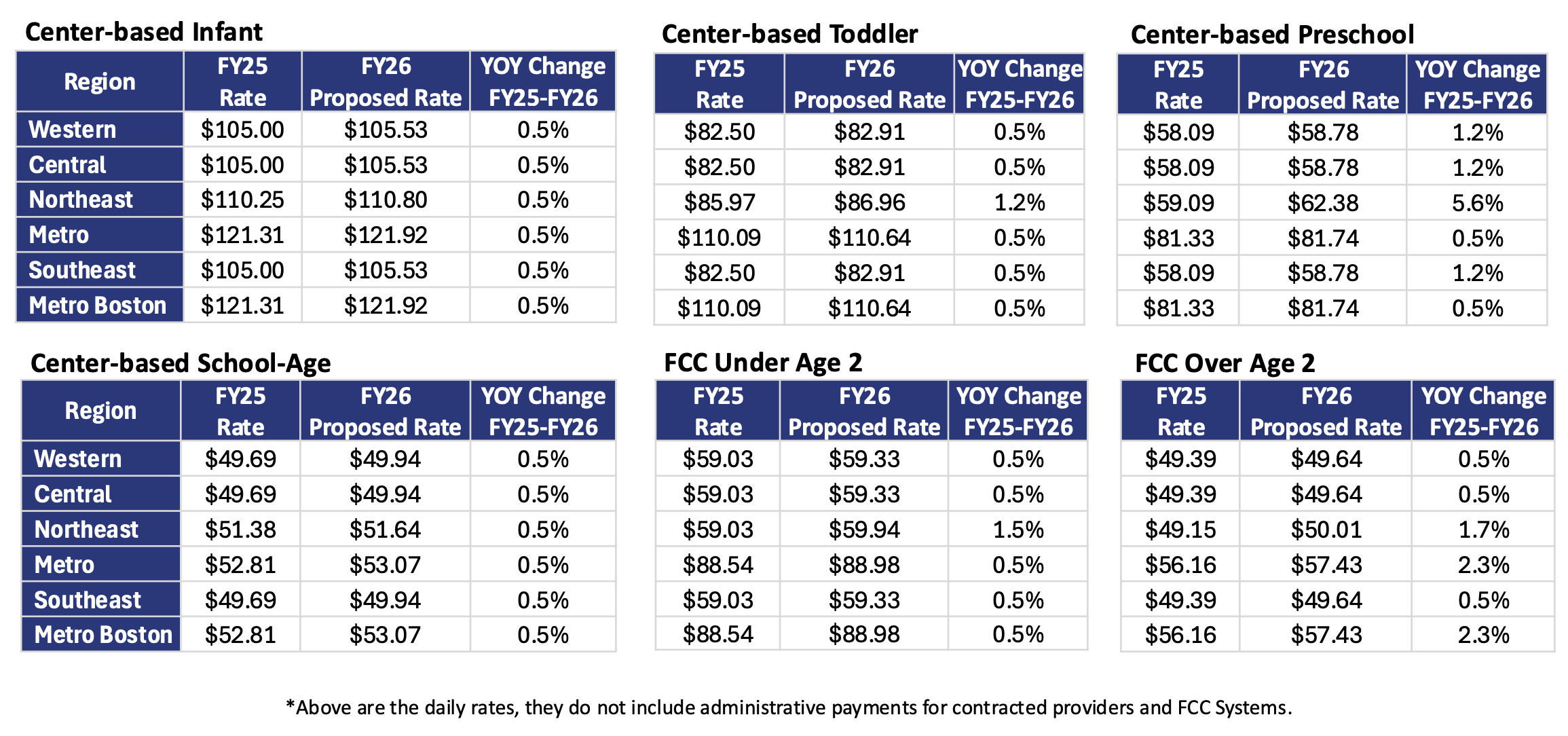
3) EEC briefly reviewed their Child Care Financial Assistance (CCFA) rate increase proposal for center-based child care (CBC) and family child care (FCC). The EEC Board voted to approve the rate increase. Twenty million dollars was appropriated in the Fiscal Year (FY) 2025 Fair Share Supplemental Budget to enable such a rate increase for FCCs and CBCs.
The rate increase will be administered in two ways: a rate increase across all rate types and additional select increases based on the cost of care and tuition prices. Both CBCs’ and FCCs’ rates will increase across the board by 0.5%. On average, this is a $0.40 increase per day, but the amount will vary as it is based on current rates which vary by location, age, and program type.
In addition, for CBCs, there will be (1) an adjustment to preschool rates for the Western, Central, Southeast, and Northeast regions as these rates have fallen below the cost of care; and (2) an adjustment for toddler rates in the Northeast region to bring the rates close to median tuition prices.
For FCCs, there will be (1) an adjustment to rates for children over the age of two for the Northeast, Metro, and Metro Boston regions as these rates are furthest from the cost of care; and (2) an adjustment for children under the age of two for the Northeast region to bring the rate more in line with the cost in other regions. SEIU Local 509, the FCC union, has agreed to the rates. The rate increases will be retroactive to July 1, 2025. See below the rate increases.
If You are an Early Childhood Educator:
1) Commissioner Kershaw announced EEC is working closely with the Office for Refugees and Immigrants on a special “Know Your Rights” training for early educators. It will be on February 26th at 6pm. You can find more information about it here.
If You are a Parent/Guardian or Child Care Advocate:
1) Commissioner Kershaw announced that the application period for EEC’s Family Advisory Council closes on February 13, 2026. They have received over 200 applications.
2) EEC Board Chair Paul Belsito recognized Cherly Travers for her time on the Board and shared that Travers’ tenure on the Board has concluded.
3) The Commissioner, Chair, and Board members offered heartfelt thanks to Dr. Secretary Patrick Tutwiler for his service as Secretary of Education and wished him well in his next role. After three years of service, Dr. Secretary Tutwiler is stepping down as Secretary. Commissioner Kershaw will serve in the role of the interim Secretary until Dr. Secretary Tutwiler’s successor, Dr. Stephen Zrike Jr., assumes the role.
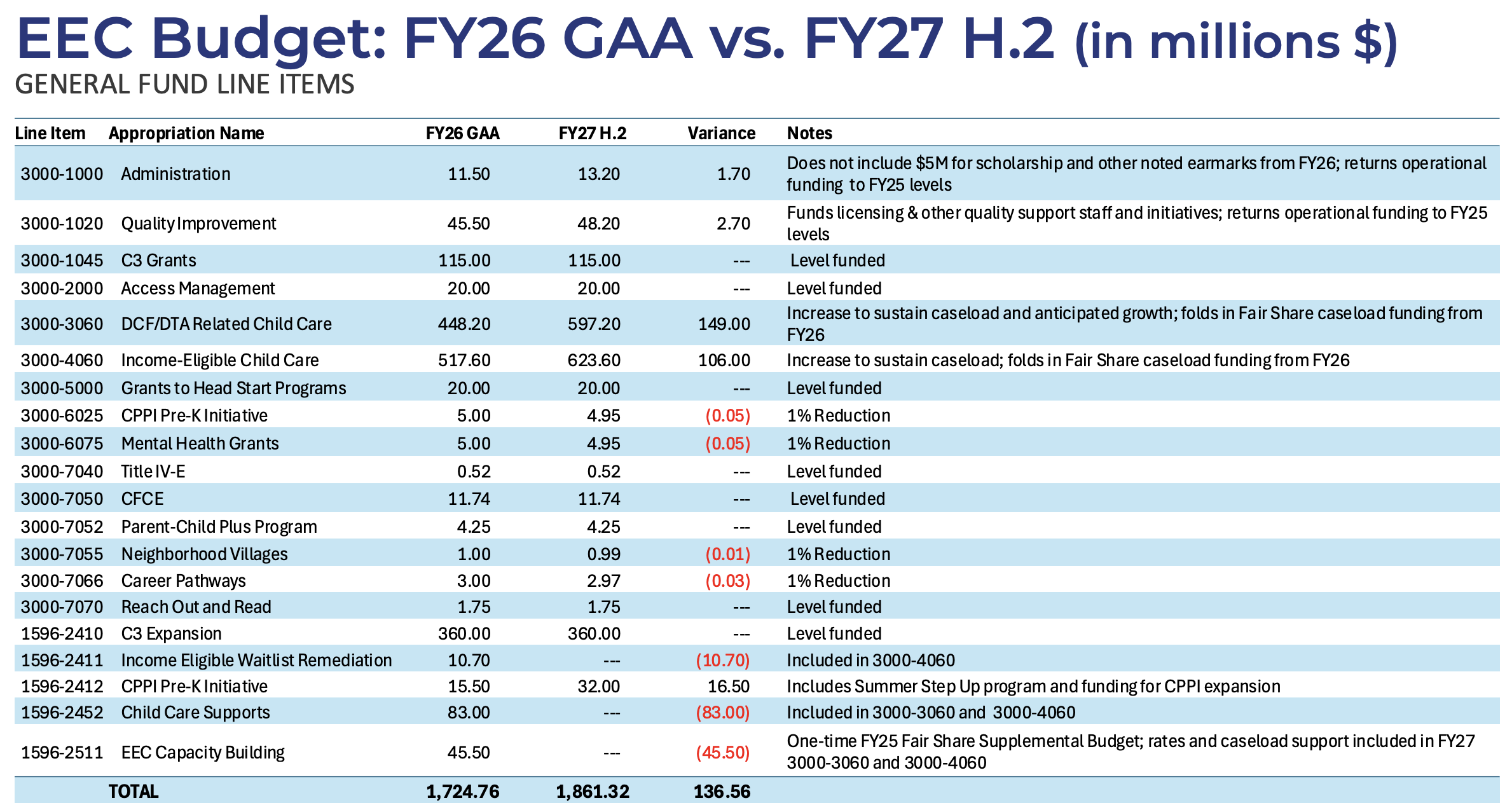
4) EEC reviewed the Governor’s FY2027 Budget Proposal for the Department of EEC. EEC shared that the Governor’s proposal is a strong start to the FY27 budget process. It funds EEC at $1.861 billion, an increase of 8% from FY26. It includes increased funding for the Commonwealth Preschool Partnership Initiatives (CPPI), which they anticipate will allow EEC to expand CCPI planning and implementation grants to all gateway cities by the end of this year. The Budget Proposal increases funding for CCFA, which will support EEC’s current caseload, growth in the Department of Transitional Assistance and Department of Children and Families caseloads, and child care access for siblings of currently enrolled income eligible families. It also incorporates the FY26 rate increase. However, EEC does not anticipate that this level of funding will open access for families on the income-eligible waitlist.
The Governor's proposal reduces funding for Career Pathways and the Early Childhood Mental Health grants. In last year’s FY26 budget, Career Pathways funding was also reduced but EEC was able to supplement that funding and increase it to $7.5 million through flexible funding they were provided in the Fair Share Supplemental Budget. This year they do not have flexible funding to increase funding for Career Pathways, but they plan to try to identify other ways to do so. The Commonwealth Cares for Children grants, Child Care Resource and Referral Services, Supplemental Grants for Head Start and Early Head Start, the Coordinated Family and Community Engagement grant program, and ParentChild+ program are funded at the same level they were funded in the FY26 budget. In addition to filing the FY27 Budget Proposal, the Governor also filed a Fair Share Supplemental Budget, which is used to partially fund CCFA. See, below, a list of the Governor’s proposed budget allocations for EEC for FY27.
Next, in April, the Massachusetts House of Representatives will develop and release their budget proposal for FY27.
5) Sam Ribnick, Executive Director of the Education-to-Career (E2C) Research and Data Hub, gave an overview of E2C. E2C is a resource created to connect data across agencies from EEC to the Department of Higher Education, Department of Economic Research, and more. E2C is working in partnership with agencies to make possible its vision that data and research are easy to access, well understood, and used to inform equitable policy, practice, and individual education choice. It is meant to be a front door hub for everything related to data.
EEC shared that the E2C hub has expanded public access to data to empower and enable researchers, programs, and communities. E2C has enabled EEC to have embedded staff to focus on their own research and data priorities, which has allowed them to build out core data governance infrastructure, research infrastructure, and capacity.
On March 11, 2026, E2C is having Open Data Day: an in-person event for people to learn about how to use data. You can learn more about the E2C Hub here.
6) EEC shared an update on their Research Agenda and discussed their 2025 research and data accomplishments. EEC’s Research Agenda is designed to complement their KPIs and support additional research and evidence that is needed to inform decision-making and program design. It includes research questions developed in partnership with EEC staff and external stakeholders that are aligned with EEC’s strategic action plan and intended to promote continuous learning and data-informed policy decisions. It is a living document that is responsive to the agency’s priorities and the evolving needs of the field and policy context. You can find EEC’s Research Agenda here.
Here are some highlights of EEC’s 2025 research and data accomplishments:
Engaged in 10 external research projects focused on topics including family needs and preferences, CCFA, apprenticeships, higher education supports, and the cost of care.
Improved public-facing data to make it more accessible and easier to navigate.
Established and convened the Data Advisory Commission to inform research and data priorities.
The next EEC Board meeting will be on March 11, 2026 in Quincy.