
Changing the System Starts with Changing the Narrative
By Sarah Siegel Muncey, President and Co-Founder
I spoke with the Boston Globe for today’s story on new research from Harvard University's Jeff Liebman into why Massachusetts families cannot get child care.
He surveyed a thousand Massachusetts mothers and found that 89 percent would use formal child care if they could afford it, but only about half currently do. His proposed starting point is not where most people would begin: pay early educators more. It sounds like it would make child care more expensive, but ultimately it does not. Better wages bring people into the field and keep them there. More educators means more classrooms can open and more seats become available. More seats means families who are shut out today can finally get care.
It took a Harvard economist, a thousand surveyed mothers, and a billion-dollar price tag to bring a complicated problem into clear focus: teacher wages are so low that they destabilize the entire child care market.
Earlier this summer, I sat down with CNN's Phil Mattingly for the network's Priced Out in America series, which asked a different question: why child care costs American families so much. Two conversations, from two directions. One asked what families pay. The other asked why the number is what it is, and landed on the fact that we don't invest in the people doing the most important teaching a child will ever receive.
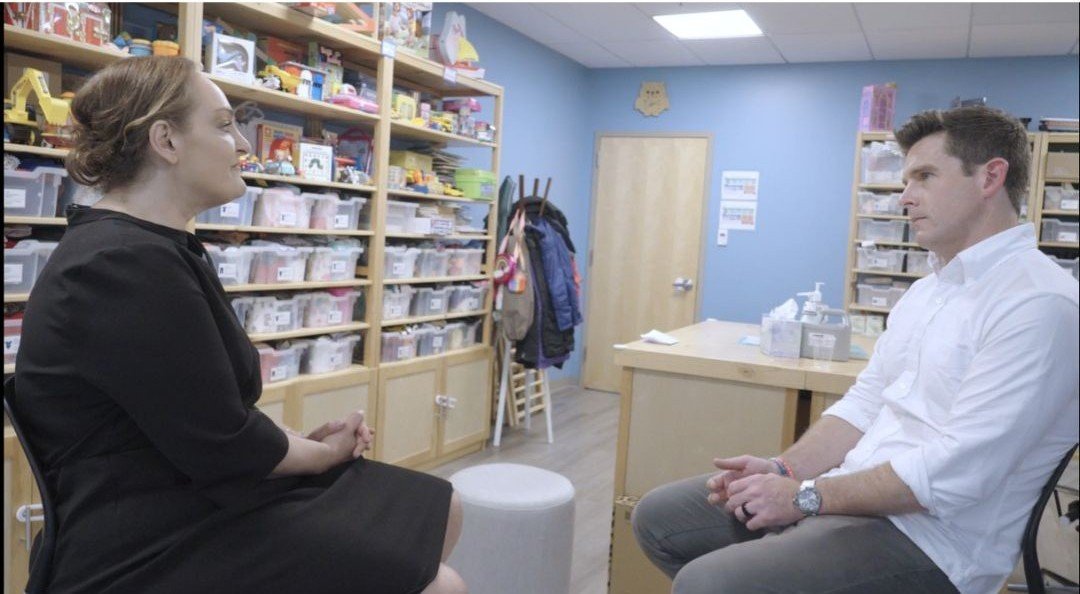
Sarah Siegel Muncey with CNN’s Phil Mattingly
Here is the thing about America's child care crisis. It is complicated. It lives in the language of subsidies and slots, reimbursement rates, and market failure. Talk about it that way for thirty seconds and you can watch people's eyes glaze over, even people who care deeply. And when a problem feels too tangled to explain, it starts to feel too tangled to fix.
At Neighborhood Villages, we believe that changing the system starts with changing the narrative. We need to fundamentally change how we view and talk about child care.
Because the truth is simple, even when the policy is not. Child care is the invisible net holding up our whole economy. It is what lets a parent go to work and a business keep its people. It is built and held together by educators, most of them women, many of them mothers and grandmothers, who shape our children's brains during the most important years of their lives, but are paid wages in the bottom five percent of all occupations. When you say it plainly, people get it. And once people get it, they are motivated to take action.
So we have made storytelling core to what we do. On CNN and in the local and national press, we translate a wonky, overwhelming problem into something you can feel in your gut. And it’s working! Our podcast, No One Is Coming to Save Us, has over one million listeners and has persisted for five seasons because people want to talk about how hard the child care crisis is in their own lives, and we’re ready to talk about how fixable it is.
To change the narrative, we take a system that feels overwhelming and break it down into doable solutions. And we pair it with the solutions providers, educators, administrators, business leaders, and families are demanding. Because a care ecosystem that works for everyone is possible.
Read the Boston Globe story: New study from Harvard offers a solution to the child care crisis: Pay workers more
On CNN: My conversation with Phil Mattingly aired this summer as part of Priced Out in America. The segment remains available to CNN subscribers.